

 5.0
5.0


Red Oak vs White Oak Flooring: Which Is Better for Your Home?
09/18/2026
Reading Time ~ 17 minutes

Table of Contents
- Red Oak vs White Oak Flooring: Key Appearance Differences
- Which Is More Durable, Red Oak or White Oak?
- Red Oak vs White Oak for Moisture and Seasonal Movement
- How Red Oak and White Oak Take Stain and Finish
- Red Oak vs White Oak Flooring Cost
- Matching Red Oak or White Oak to Existing Hardwood Floors
- Which Oak Flooring Should You Choose?
Red Oak vs. white oak flooring comes down to appearance, finish goals, household use, and budget. White oak has a more neutral color, a tighter-looking grain, slightly higher Janka hardness, and lower liquid permeability, while red oak has warmer pink and reddish undertones, a more pronounced grain pattern, and often a lower material cost.
Key Takeaways
- Choose white oak if you want light brown, beige, taupe, or natural finishes with a calmer, more contemporary look.
- Choose red oak if you prefer warmer character, stronger visible grain, or need to match existing Red Oak floors, stairs, or trim.
- White oak is slightly harder at about 1360 Janka versus about 1290 for Northern red oak, but the difference in normal residential use is modest.
- White oak handles liquid penetration better, but neither species is waterproof.
- Both oak species take stain well, although their undertones make the same stain color look different.
- For pets, kids, and high-traffic areas, finish system, sheen, and maintenance can matter as much as species.
Red Oak vs White Oak Flooring: Key Appearance Differences
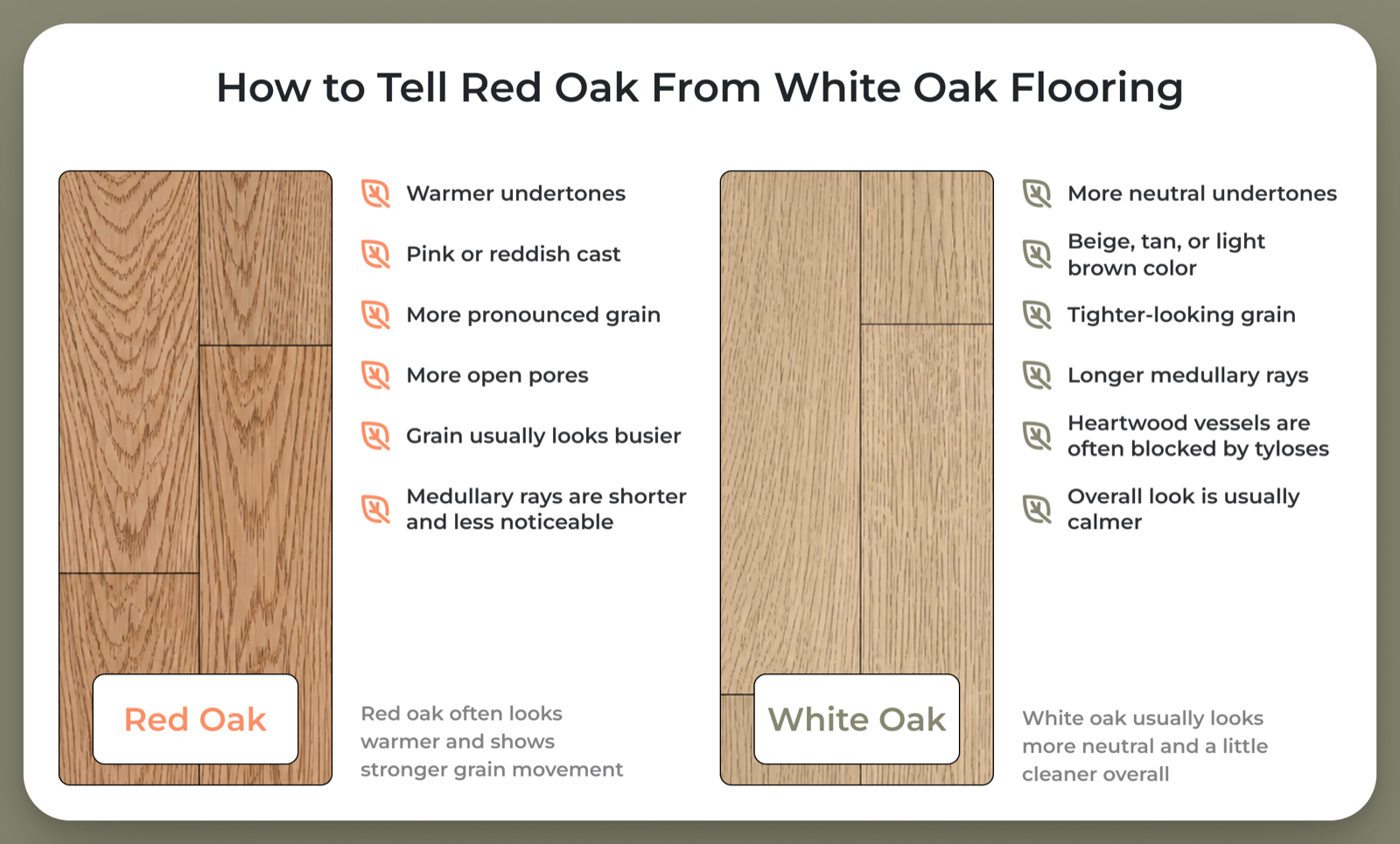
Red oak usually looks warmer and has more noticeable grain. White oak tends to look more neutral and a little cleaner overall, which is one reason it works so well with lighter and more natural finishes.
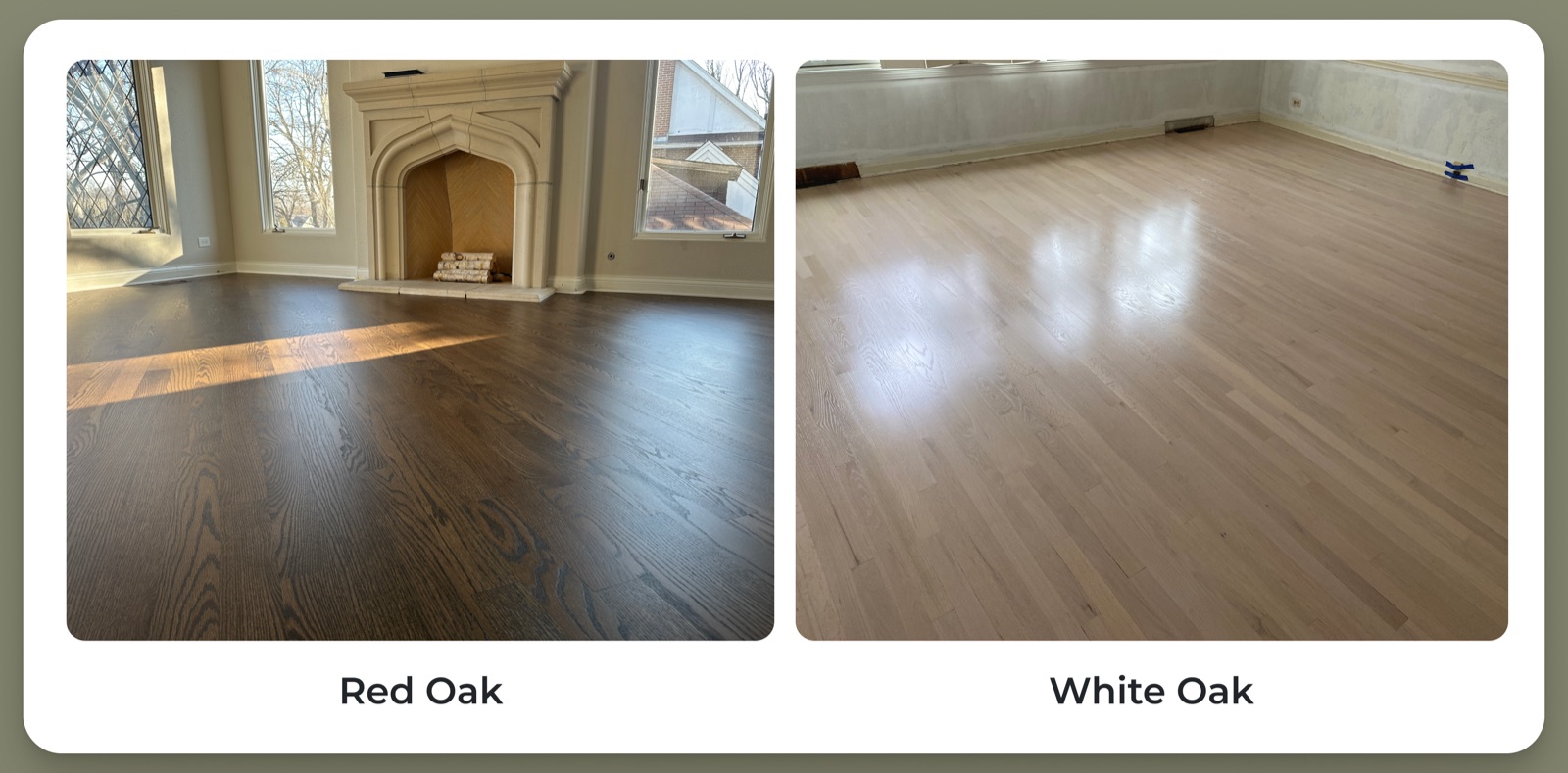
The biggest visual differences are:
- Natural color: Red oak usually has a light brown base with pink, salmon, or reddish tones. White oak is more often beige, tan, light brown, or slightly gray. Neither name tells the whole story. Red oak is not always very red, and white oak is definitely not white. The National Wood Flooring Association notes that red oak can range from light reddish tan to deeper reddish brown, with noticeable natural color variation.
- Grain pattern: Red oak has a more open and pronounced grain, so the floor usually looks busier and shows more movement from board to board. White oak grain is generally tighter-looking and more even. It also has longer and more pronounced medullary rays than red oak, which can become especially noticeable depending on how the boards are cut.
- How the wood is cut: Plain-sawn oak gives you the familiar cathedral grain seen in many traditional oak floors. Rift-sawn boards look straighter and quieter, while quarter-sawn boards show more ray fleck. Because of that, a rift-sawn red oak floor can sometimes look calmer than a plain-sawn White oak floor.
- Wood grade: Select grade usually looks cleaner and more uniform. Common and Character grades have more knots, mineral streaks, and color variation. That can change the look of the floor just as much as the species itself.
- Lighting: Daylight, warm bulbs, wall colors, and nearby cabinets can all change the way the wood reads. Pink tones in red oak may stand out more in one room and barely show in another.
Which Is More Durable, Red Oak or White Oak?
White oak is a little harder than red oak, but in a normal home the difference is not huge. Both can last for decades, and the finish, traffic, pets, dirt, and basic care often matter just as much as the species.
Janka Hardness, Dents, and Everyday Damage
White oak is slightly harder than Northern red oak, so it has a small advantage when it comes to dents. Still, both are strong hardwood flooring options for regular residential use.
On the Janka hardness scale, white oak is about 1360, while Northern red oak is about 1290. This test measures how much force it takes to press a steel ball into the wood, so it mainly tells us how resistant the wood is to dents and pressure. The National Wood Flooring Association uses the Janka scale to show how well a wood species can handle dents and dings.
In real life, the difference between 1290 and 1360 is pretty small. A heavy piece of furniture, a dropped pan, or a sharp heel can still dent either floor.
There is also some variation within the species. Northern red oak is around 1290 Janka, while Southern red oak is closer to 1060.
So we look at the Janka number as a useful reference, not as a guarantee. White oak has a small advantage, but neither floor is dent-proof.
Scratches, Pets, Kids, and High-Traffic Homes
A harder floor does not automatically mean fewer scratches. Most light scratches happen in the finish on top of the wood, while the Janka rating tells us more about dents in the wood itself.
In a busy home, these things usually make the biggest difference:
- Pets: Dog nails can scratch the finish, especially if the finish is already worn. Water bowls and pet accidents should also be cleaned up quickly.
- Dirt and grit: Sand and small debris get dragged across the floor under shoes and act like sandpaper. Good entry mats and regular cleaning help a lot.
- Furniture: Chairs and other furniture can scratch the finish or leave dents. Felt pads are an easy fix.
- Kids: Toys, dropped objects, and constant traffic add wear, but both red oak and white oak handle normal family life well.
- Sheen: Matte and satin finishes usually hide small scratches better than glossy finishes.
- Stain color: Very dark floors tend to show dust, pet hair, and light scratches more easily. Medium and natural colors are usually easier to live with.
Grain also plays a part. Red oak has a stronger grain pattern, and that can help hide small scratches and dents. White oak looks cleaner and more even, but that does not always mean it hides wear better.
This is why we would not choose between red oak and white oak only by looking at the Janka number. In a high-traffic home, the finish, sheen, color, maintenance, and daily use can make a bigger difference.
Red Oak vs White Oak for Moisture and Seasonal Movement
White oak does a better job slowing down liquid penetration, but that is different from how the floor reacts to changes in indoor humidity. Spills are one issue. Seasonal expansion and contraction are another.
Which Oak Handles Spills and Moisture Better?
White oak has better resistance to liquid penetration because the vessels in its heartwood are commonly blocked by tyloses. Red oak has more open vessels, so liquid can move into the wood more easily.
That gives white oak a small practical advantage in places where spills happen more often, such as:
- kitchens
- dining rooms
- entryways
- mudrooms
- homes with pets
That does not make white oak waterproof. Standing water can damage either species, especially if it gets through seams, worn finish, damaged areas, or exposed wood.
The finish is still the first layer of protection. Once the finish starts wearing through, the wood underneath is much easier to damage.
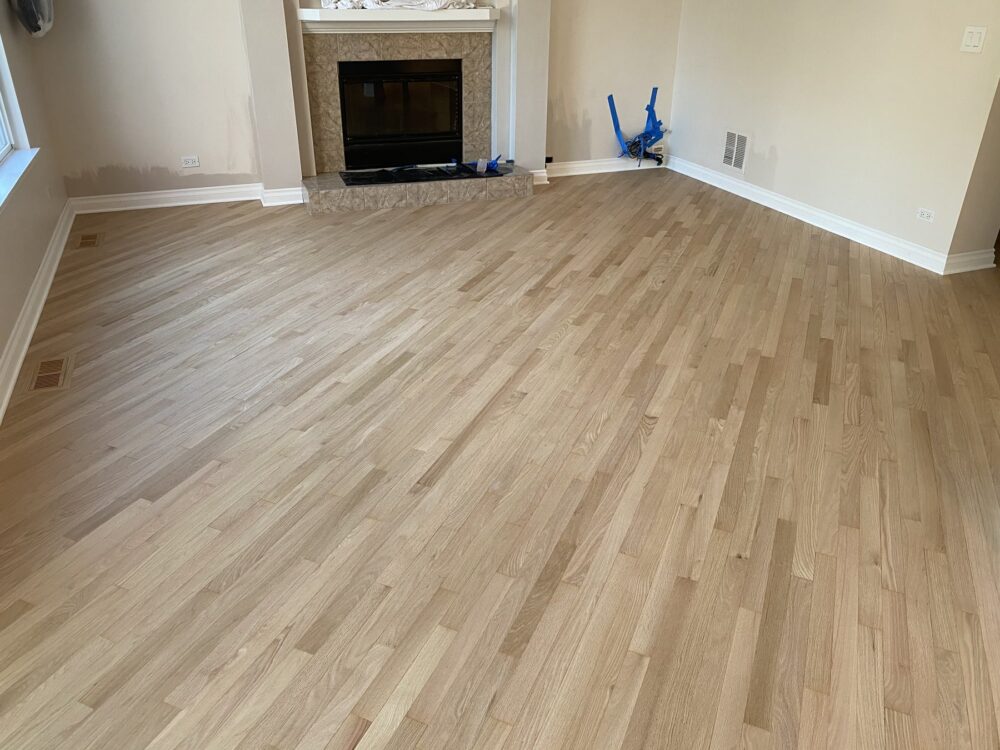
So yes, white oak handles liquid better than red oak. But both floors still need spills cleaned up quickly.

Professional Hardwood Floor Refinishing
Humidity, Expansion, Gaps, and Cupping
White oak being less permeable does not mean it automatically moves less with seasonal humidity. Both red oak and white oak take in and release moisture from the air.
When indoor humidity goes up, the boards can gain moisture and expand. When the air gets dry, they lose moisture and shrink.
That is why you may see:
- small gaps during dry winter months
- tighter seams during humid months
- cupping when moisture is higher on one side of the board
- expansion when moisture levels get too high
- cracks or larger gaps when conditions stay too dry
Some seasonal movement is normal. The NWFA recommends keeping the home between 30 to 50 percent relative humidity and 60 to 80°F year-round to help reduce excessive gaps, splits, and other moisture-related problems.
A few other things matter just as much as the oak species.
Plank width matters. Wide planks show more movement across each board, so moisture control becomes more important as boards get wider.
Solid vs. engineered matters. Engineered hardwood is built in layers and usually handles changes in moisture differently from solid wood. Over concrete or in other moisture-sensitive areas, construction type can matter more than choosing red oak or white oak.
Saw cut matters. Plain-sawn, rift-sawn, and quarter-sawn boards do not move exactly the same way because the growth rings sit differently inside the board.
The subfloor matters. A wet concrete slab, damp crawlspace, or unstable wood subfloor can cause problems no matter which oak species you install.
Acclimation matters. Hardwood should not be installed just because it sat inside the house for a few days. The moisture content of the flooring needs to be right for the actual conditions in the home.
The simple version is this: white oak is better at slowing down liquid, but a stable floor depends on the whole hardwood floor installation service. A properly installed red oak floor can perform better than a poorly installed white oak floor.
How Red Oak and White Oak Take Stain and Finish
Both red oak and white oak take stain very well, but they do not finish the same way. Natural color, grain, pore structure, sanding, and the finish system all affect the final result, so the right stain depends on the wood underneath it.
The Same Stain on Red Oak vs White Oak
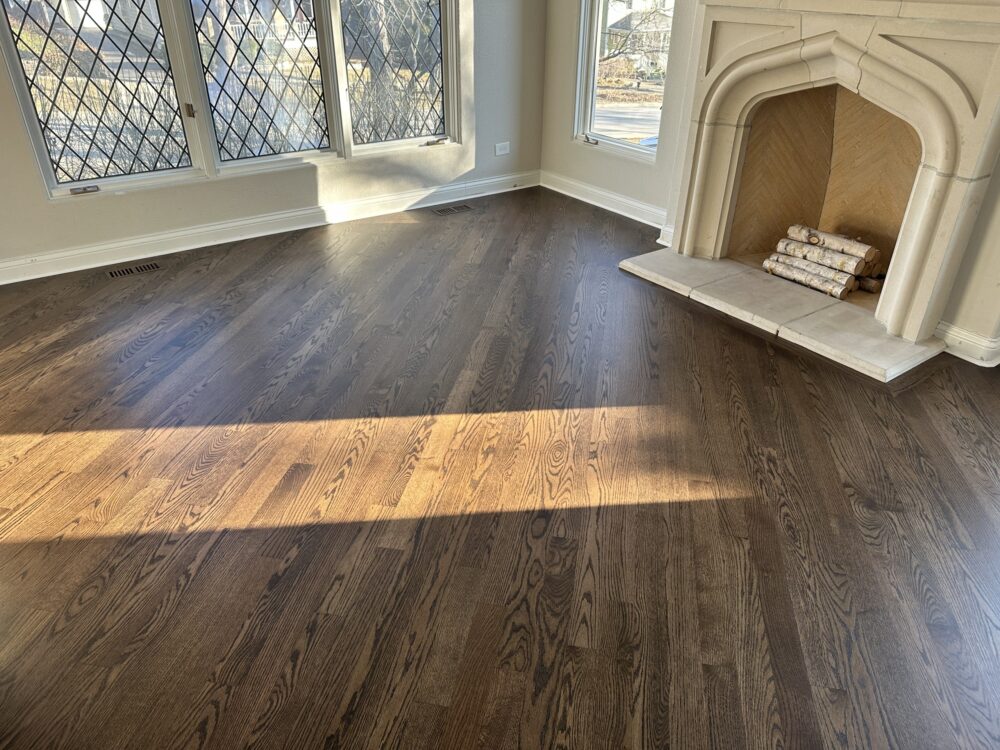
The same stain color will usually look different on red oak and white oak. Red oak starts with warmer pink and reddish tones, while white oak usually has a more neutral light brown base, and those undertones still show through because stain colors the wood instead of covering it like paint.
Red oak has a more open and pronounced grain, so stain often creates stronger grain contrast. White oak also has an open grain, even though it is sometimes described as closed grain, but its texture usually looks tighter and more even. Red oak has a slightly coarser, more porous grain than white oak.
That is why a medium brown stain may look warmer and more active on red oak but more neutral on white oak. The product can be identical. The wood underneath is not.
Sanding matters too. Final grit and sanding sequence affect how evenly the surface accepts color, and grit selection can change the final appearance and performance of a finish. Water popping can deepen the stain even more by lightly wetting the sanded surface before color is applied.
Lighting can change the result after the floor is finished. A sample that looks neutral under shop lighting may look warmer next to beige walls, cabinet doors, or warm bulbs.
That is why we prefer making stain samples on the actual floor whenever possible. You see the real species, sanding, stain, lighting, and finish together.
Light, Natural, Gray, and Dark Finishes
White oak usually gives you more flexibility with lighter stains and neutral colors, while red oak naturally works well with warmer browns. Both species can go light or dark, but their starting color still affects the result.
For a natural or raw wood look, white oak is usually easier to keep neutral because of its beige and light brown base. Red oak also looks good with natural finishes, but its pink and reddish hue will usually stay more noticeable.
The topcoat also changes the color. Water-based finishes are normally clear, while oil-based finishes have an amber color. A water-based system usually keeps oak closer to its freshly sanded color, while an oil-based finish adds more warmth.
For whitewash, beige, greige, taupe, and gray, white oak generally gives you a cleaner starting point. Red oak can take lighter stains too, but the warm base may push through if the stain system does not neutralize it enough.
For medium brown and dark finishes, both species are easy to work with. As the stain gets darker, the natural color difference becomes less obvious, although red oak and white oak still keep different grain patterns and texture.
Oak is popular partly because it accepts stain so well.
White oak wood does have one extra finishing detail. It contains a high level of tannins, which can react with water, iron, or certain finishing products and create gray, brown, green, or dark discoloration. These reactions can also be used intentionally for special finishes, but they need to be controlled.
The practical rule is simple. Choose the stain on the actual species you are installing, not from a stain chart alone.

Can Red Oak Be Made to Look More Like White Oak?
Yes, red oak can be made lighter and more neutral, and a good stain system can reduce a lot of the pink and red. But red oak cannot be turned into white oak because the natural grain, pores, and wood structure remain different.
This comes up often when homeowners already have red oak hardwood flooring but prefer the lighter look of newer white oak flooring. In many cases, a good existing floor can be refinished instead of replaced just for color.
A contractor can move red oak in a more neutral direction in several ways:
- Color correction: Green sits opposite red on the color wheel, so controlled green tones can reduce some of the red in the wood. Hardwood Floors Magazine discusses using green to neutralize red tones in red oak.
- Custom stain systems: Beige, brown, gray, white, and other tones can be blended to create a more neutral finish direction.
- Tinted water popping: Small amounts of color can be introduced during the water-popping process before stain is applied.
- Wood bleach: Professional bleaching systems can reduce some of the natural pink and red before staining, but the process needs to be tested carefully.
- Clearer topcoats: A water-based finish adds less amber color than a traditional oil-based finish, which helps keep lighter floors from becoming warmer.
There are limits. The color can move much closer to a white oak look, but the visible grain and texture will still read as red oak.
That is why the goal should be a good-looking neutral red oak floor, not trying to make one species perfectly imitate the other.
Red Oak vs White Oak Flooring Cost
White oak usually costs a little more than red oak, but the final difference depends heavily on the product you choose. Grade, plank width, saw cut, construction, and installation can move the price much more than the species alone.
For materials in 2026, red oak flooring generally runs about $5 to $11 per square foot, while white oak flooring is commonly around $5 to $12 per square foot. Current installed-cost estimates put red oak at roughly $9 to $20 per square foot and white oak at about $10 to $24 per square foot, although labor and prep costs vary a lot by location and project.
White oak often carries a higher price because it is in strong demand, especially for cleaner grades, neutral finishes, and wider boards. Red oak is widely available and remains one of the more affordable domestic hardwood flooring options.
The species is only the starting point. These choices can change the price quickly:
- Wood grade: Select and clear grades cost more because they allow fewer knots, mineral streaks, and strong color variation. Common and Character grades usually cost less and have a more natural, varied look.
- Plank width: Wide planks usually cost more than standard strip flooring. This can be especially noticeable with wide white oak.
- Saw cut: Plain-sawn flooring is the most common and usually the least expensive. Rift-sawn and quarter-sawn boards cost more because the milling is more selective and produces less usable flooring from the log.
- Solid vs engineered: There is no rule that engineered hardwood is always cheaper. A premium engineered white oak with a thick wear layer can cost more than standard solid red oak flooring.
- Unfinished vs prefinished: Unfinished hardwood still needs sanding, stain if desired, and finish after installation. Prefinished flooring includes the factory coating in the material price.
- Installation and prep: Removal of old flooring, subfloor repairs, leveling, moisture work, glue-down installation, stairs, and complicated layouts can add much more to the total than the difference between red and white oak.
So, is white oak worth the higher cost? It usually is if you specifically want its natural color, tighter-looking grain, wide-plank look, or lighter finish direction. If you like red oak or already have red oak floors throughout the house, paying extra just to switch species usually does not give you a meaningful durability upgrade.
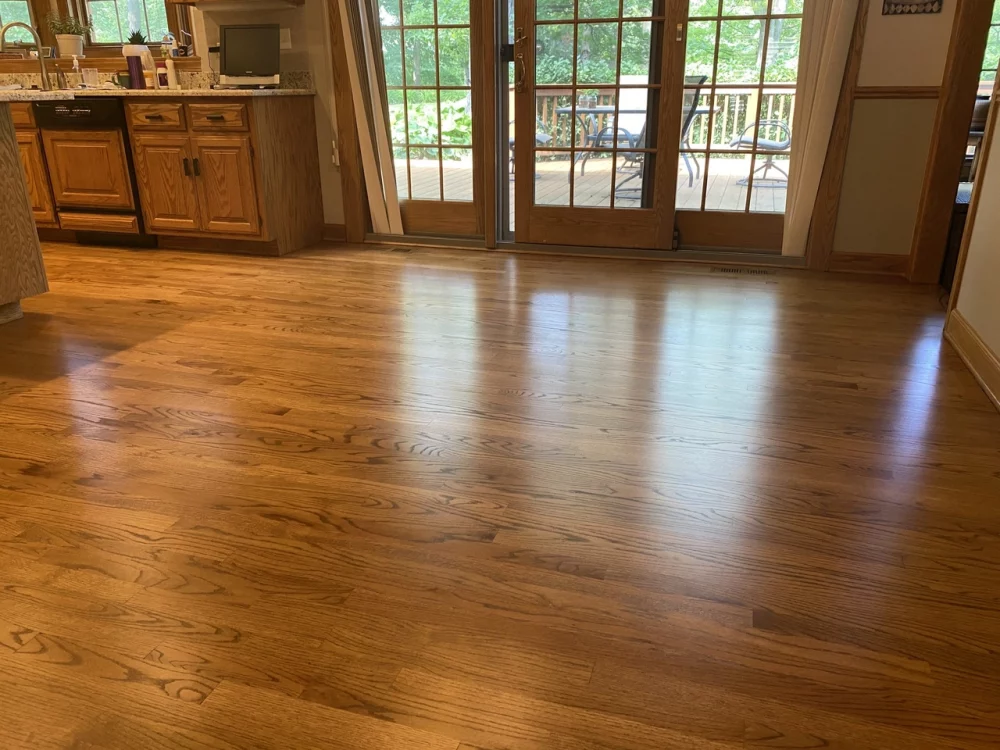
Real Project Cost: 1,350 Sq. Ft. Red Oak Floor in Wheaton
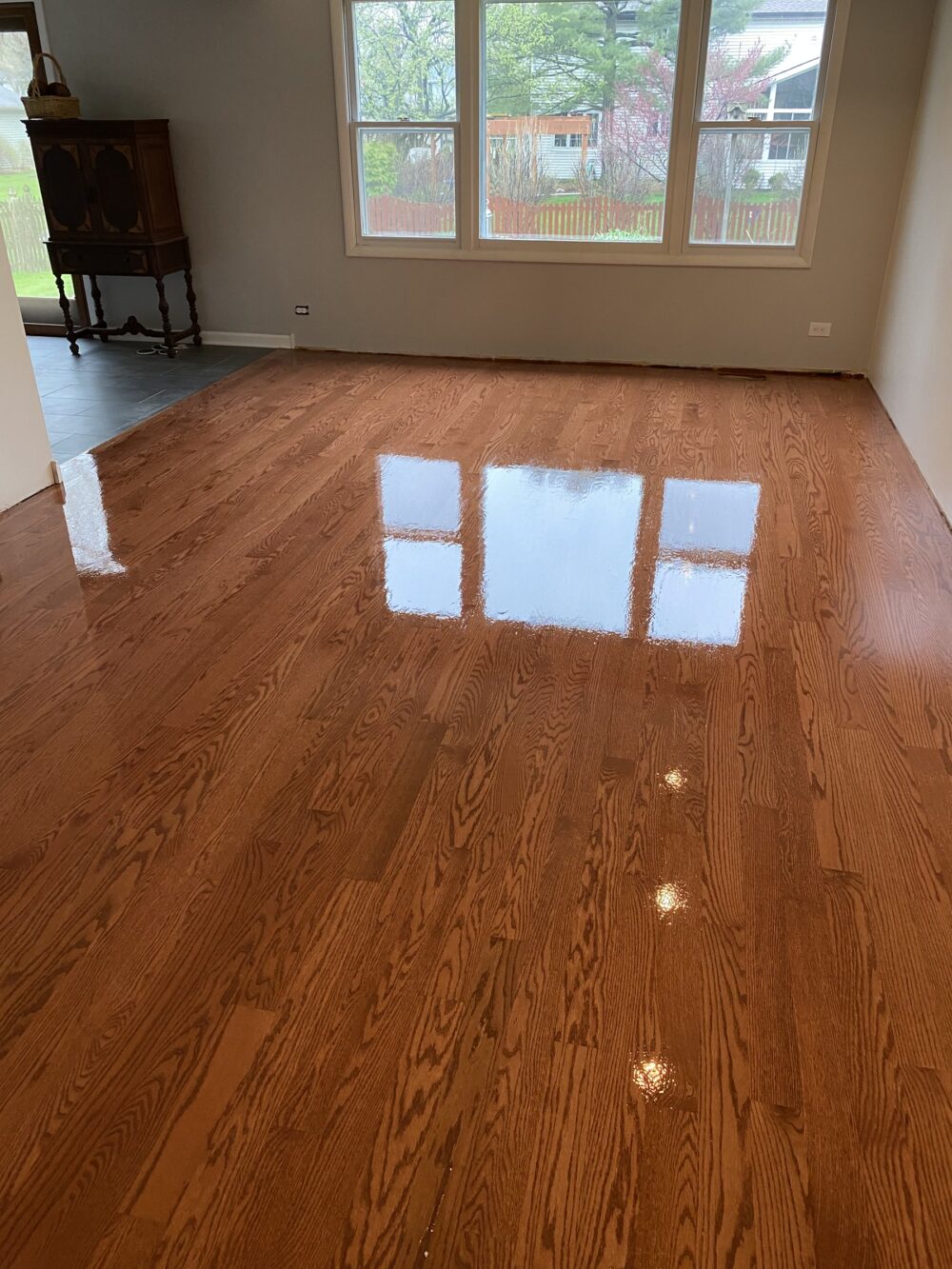
We had a 1,350-square-foot project in Wheaton where the existing floors were badly damaged and needed to be replaced. We removed the old flooring, repaired sections of the subfloor, installed new 5-inch red oak hardwood, sanded the floor, applied Bona Early American stain, and finished it with Loba 2K Duo.
For that full scope, the project cost was approximately $16,000 to $20,000 before the cost of the new hardwood material. That comes out to about $11.85 to $14.81 per square foot for demolition, subfloor work, installation, sanding, staining, and finishing.
This is a good example of why looking only at the price of red oak vs white oak flooring can be misleading. On a real installation, the condition of the existing floor and subfloor, plank width, installation method, and finishing work can have a much bigger effect on the final bill.

Hardwood Floor Installation in Chicago and suburbs
Matching Red Oak or White Oak to Existing Hardwood Floors
If you are repairing, extending, or refinishing an existing floor, matching the species is usually more important than deciding which oak is better overall. Red oak and white oak can be brought closer in color, but the grain and pore structure can still look different.
A few things help when identifying the existing floor:
- Color: Red oak often has warmer pink or reddish tones, while white oak is usually more beige, tan, or light brown.
- Grain: Red oak usually has a more open, pronounced grain. White oak tends to look tighter and often shows longer medullary rays.
- Pores and end grain: White oak heartwood vessels are commonly blocked by tyloses, while red oak vessels stay more open.
- Stain: Once the floor is stained, color becomes much less reliable as an identifier.
- Hidden areas: A floor vent opening, unfinished board edge, or spot exposed during a repair can give you a much better look at the actual wood.
For hardwood floor repair services and additions, we usually try to match the existing species first. This matters when:
- replacing damaged boards
- extending hardwood into another room
- connecting new flooring to an older section
- refinishing connected rooms
- matching stair treads and landings
- matching railings or existing trim
Mixing red oak and white oak can work if the contrast is intentional. If the goal is a seamless repair or extension, matching the original species is the safer choice.
Which Oak Flooring Should You Choose?
If you are choosing between red oak and white oak, start with the look you want and what is already in the house. Both are durable hardwood flooring options, so the better choice usually comes down to color, grain, budget, and the type of project.
| Feature | Red Oak | White Oak |
|---|---|---|
| Natural color | Light brown with pink or reddish tones | Beige, tan, light brown, sometimes grayish |
| Grain | More pronounced and active | Usually calmer and tighter-looking |
| Janka hardness | About 1290 for Northern red oak | About 1360 |
| Dent resistance | Very good | Slightly better |
| Liquid penetration | More permeable | Less permeable because of tyloses |
| Light neutral stains | Possible, but warm undertones may need correction | Usually easier to keep neutral |
| Dark stains | Works very well | Works very well |
| Wide-plank look | Available | Especially popular |
| Existing floor matching | Best choice for existing red oak | Best choice for existing white oak |
| Typical material cost | Usually lower | Usually higher |
| Best fit | Warm character, visible grain, matching existing floors | Neutral colors, calmer grain, contemporary finishes |
Red oak usually makes more sense when:
- you already have red oak floors and want the new work to blend in
- budget matters
- you like a stronger, more visible grain
- warm and traditional finishes fit the house
- the existing floor is still in good shape and can be refinished instead of replaced
White oak usually makes more sense when:
- you want a light, neutral, or natural finish
- you prefer a calmer grain pattern
- wide planks are part of the design
- lower liquid permeability is useful
- the stain color you want works more naturally with white oak
There are also projects where the red oak vs white oak decision is not the most important one. Over concrete, in basements, with radiant heat, or with very wide planks, we pay more attention to engineered vs solid construction, moisture conditions, subfloor prep, and professional installation.
At Big Bro Hardwood, we would not recommend replacing a good red oak floor just because white oak is more popular right now. If the floor is in solid condition, we can usually sand it, adjust the stain color, and refinish it into a much cleaner and more updated look.
If you are installing new hardwood from scratch and want a light, neutral floor with calmer grain, then white oak is often the better starting point. If you need professional hardwood refinishing services or a new hardwood floor installation, we can help you choose the right option for your home.
frequently asked questions
Does White Oak Add More Resale Value Than Red Oak?
Not automatically. Buyers may prefer white oak in some homes, but floor condition, installation quality, finish, and how well the flooring fits the house usually matter more than the species alone.
Do Red Oak and White Oak Change Color Over Time?
Yes. UV exposure, natural aging, and the finish system can slowly change the color of both species. Areas under rugs or furniture may age differently because they receive less sunlight.
Can Red Oak and White Oak Floors Be Refinished Multiple Times?
Yes, solid red oak and white oak can usually be sanded and refinished several times if enough wood remains above the tongue and groove. With engineered hardwood, the number of refinishes depends mainly on the thickness of the wear layer.


Overall rating
No votes so far! Be the first to rate this post.
Comments